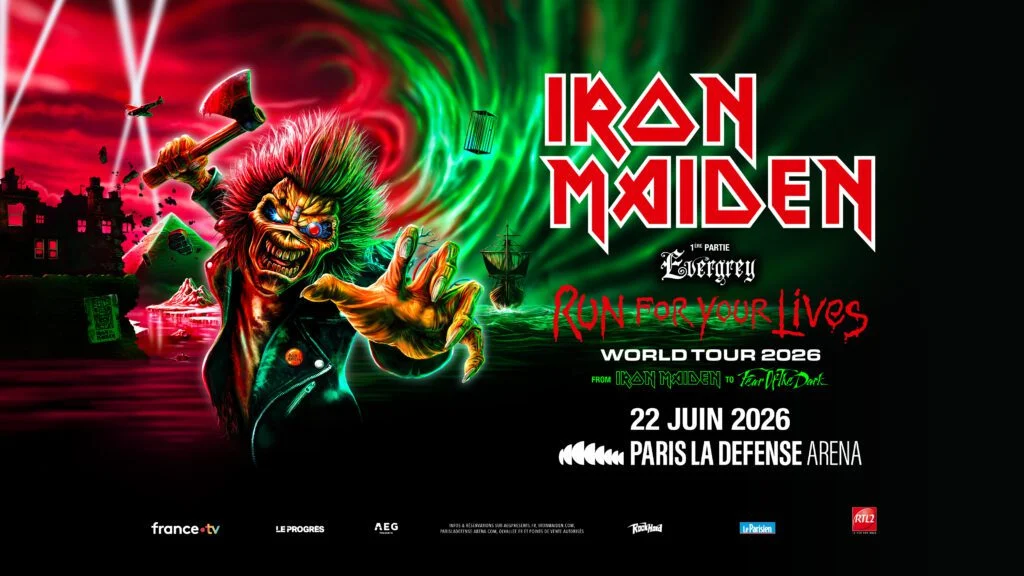
Eleven months after having already lit up Paris La Défense Arena for two consecutive nights, Iron Maiden returns to familiar ground to celebrate fifty years of their career. An official recording, a phone-free pit, and a red-alert heatwave: this date had all the markings of an extraordinary rendezvous. But not everything went as planned: tonight, history was also written in the dark.
Evergrey: The Shadows of Gothenburg
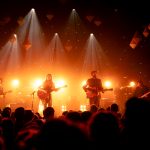
7:20 p.m. Under a golden backdrop stamped with the band’s logo, EVERGREY steps into an Arena still filling up. The Swedes present clean, solid progressive metal, sometimes very classical, propelled by a balanced sound and a vocally impeccable Tom S. Englund. The guitars shine with generous solos, while the synths add a symphonic emphasis that works best when the band allows its atmospheres to breathe. Unsurprisingly, the set foregrounds Architects Of A New Weave, the group’s fifteenth studio album released earlier this month. For a formation that has spent over thirty years on the road, Evergrey sometimes lacks surprise or bite, but the performance remains precise and elegant. For those who would like to see the quintet in a longer format, head to Petit Bain on December 7.
The Cavalry in the Furnace
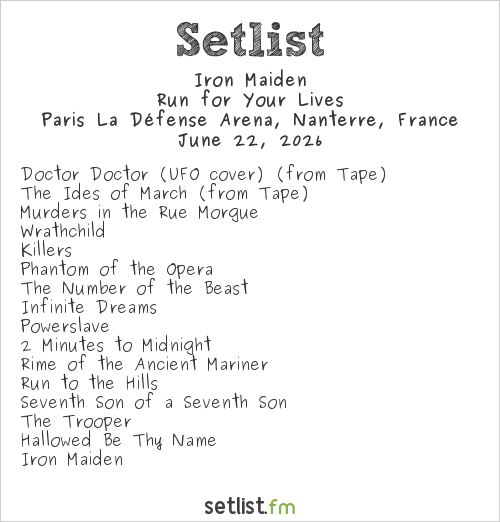
8:50 p.m. UFO’s “Doctor Doctor” wakes the faithful, “The Ides Of March” unleashes the cavalry, and the screens plunge the Arena into dark alleyways, lit like an old London nightmare. In the pit, the phones sleep in Yondr pouches: for once, arms rise not to film, but to salute the arrival of Bruce Dickinson and his bandmates. The opening volley, aimed toward Killers, whose cover lights up the back of the stage, tastes like heavy metal still dirty, primitive, and almost punk. “Murders In The Rue Morgue” and “Wrathchild” bite just before Eddie makes his first appearance, a battle-axe in hand, to provoke Steve Harris on “Killers.” Let’s be honest: Bruce Dickinson‘s performance has nothing to blush about next to Paul Di’Anno, the singer on that cult album by the Iron Maiden saga.
A Half-Century of Heavy Metal
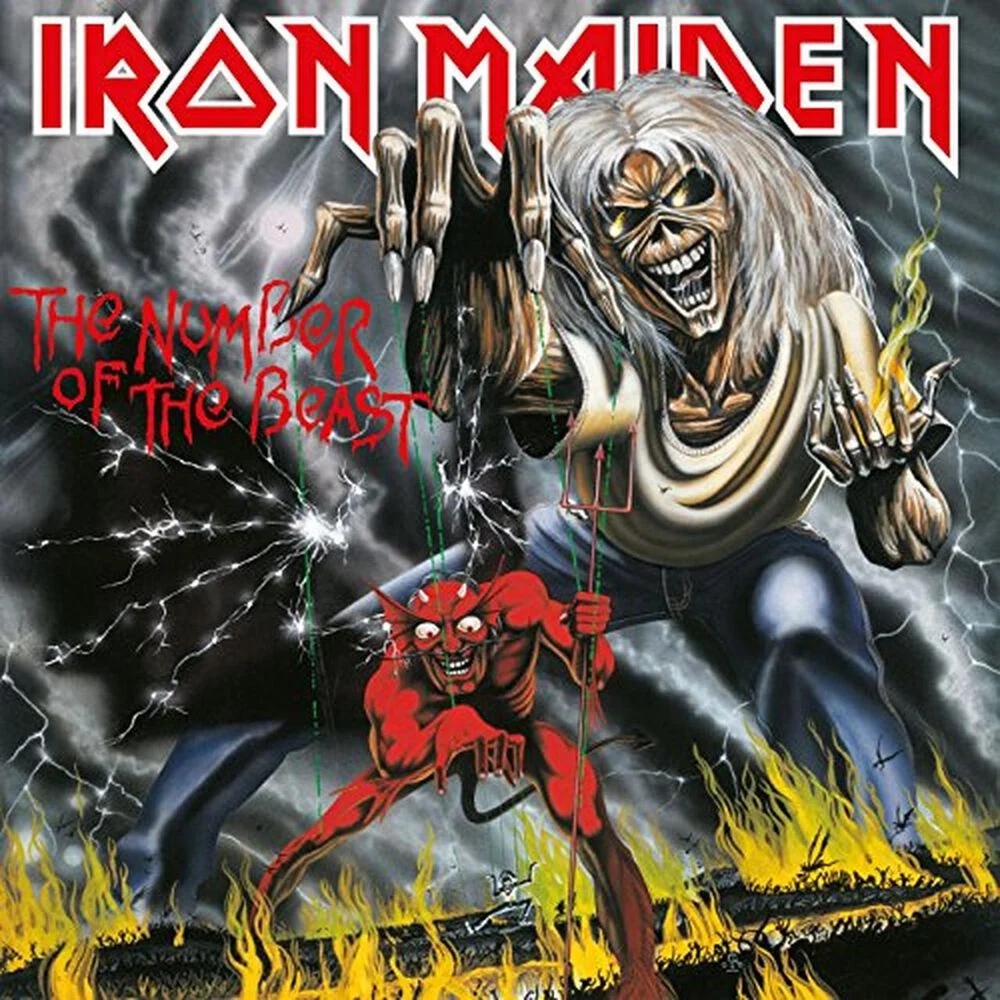
The six musicians occupy the vast stage with undiminished appetite. The three guitarists take turns with solos and swings around the body, while Steve Harris mows the crowd with his bass. A classic that even the most devoted fans do not tire of, forty-six years after Iron Maiden’s first show in Paris. Bruce Dickinson consumes space as if the Arena were too small for his energy: sprints from end to end, generous haranguing, and soaring vocal lines are on the program. “It’s you who are the audience of the world tonight,” the seventy-year-old frontman proclaims in utterly perfect French. On the production side, the show is not to be outdone, featuring a vision of the Eiffel Tower threatened by a red-green storm of striking effect. The unflappable “The Number Of The Beast” lights up the screen with its fiery visions and Nosferatu imagery. For its half-century of existence, Maiden traces and reshapes its own history into a living set.
The Pyramid Collapses
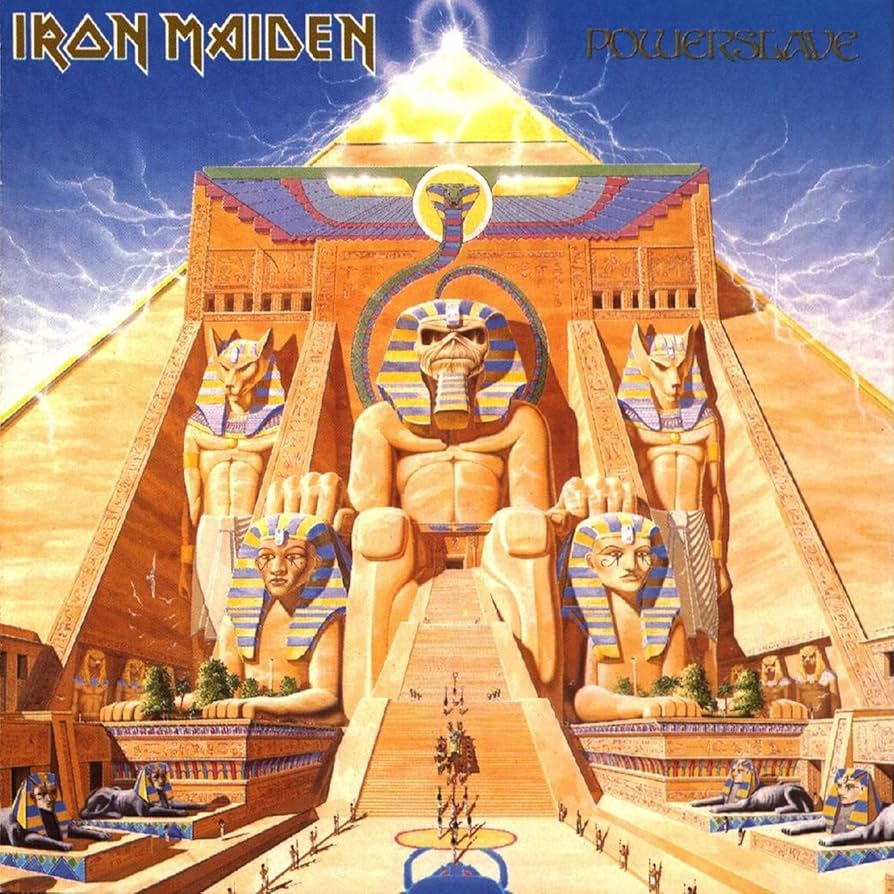
Then the iconic Powerslave opens its golden tomb. Between the giant pyramid and flames bursting from all sides, the staging is as massive as it is immersive: no surprise for a concert filmed for a forthcoming official release. On a second stage deployed for the occasion, Bruce Dickinson rises higher, masked in Eddie’s likeness, like a pharaoh of heavy metal ruling over his Egyptian empire. The cruising pace is set, and nothing seems able to slow the war machine that is Iron Maiden. The epic “Two Minutes To Midnight” charges forth in a feverish ambience… then everything freezes. Sound, image, light: complete darkness spreads through the Arena and its roughly 30,000 spectators from around the world. What is happening?
Saving the Embers
To cut to the chase: the outage lasts nearly an hour. An hour of waiting and hesitation, with air conditioning that seems to have vanished along with the rest. Deprived of the concert for an undetermined duration, the audience remains remarkably calm. At 10:45 p.m., Bruce Dickinson returns alone on stage. Very agitated, but in perfectly fluent French, he announces that the show will resume, shortened by a non-negotiable curfew set at 11:30 p.m. Disappointment is quick to arrive, but Dickinson’s line—“I prefer Bercy”—proves the feeling is mutual across the stage. Then Maiden resumes, without a backward glance. In thirteen minutes, “Rime Of The Ancient Mariner” reawakens the sea. The interruption has broken the momentum, but not the band’s ability to rebuild an atmosphere in a few minutes.
Die With Your Boots On
For the last holdouts, “Run To The Hills” rekindles the collective instinct, before “Seventh Son Of A Seventh Son” restores the show’s narrative dimension. Bruce Dickinson, masterful in control, recaptures the theatricality that makes each long song a living, epic tale. On “The Trooper”, banner in hand, he dominates the stage as Eddie returns in uniform to the cheers of the Arena. Soon, the French flag waves before a highly excited crowd. “Hallowed Be Thy Name” then plunges the show back into the dark alley of the beginning. The incident may have been forgotten, but eyes stay fixed on the clock. It is past 11:30 p.m. when “Iron Maiden” closes the night, Eddie emerging once more from the screen, leading the six musicians in his wake. There will be no encore.
The Iron Maiden Stands Tall
Beyond the outage, the most painful part of this experience lies in the loss of “Fear Of The Dark,” “Wasted Years,” and “Aces High.” Three classics that are considered a given at every Maiden show, three heavy metal anthems that will remain in everyone’s minds tonight without having shone in the Arena. In its statement the following day, Iron Maiden acknowledged the general frustration, while recalling that this date was intended to be filmed “for a later release.” What will remain of this recording? A mystery. Despite the incident, the anger and the long minutes lost, the Iron Maiden stood tall, offering a resilience exercise that deserves applause. So let us pray, with fists raised, that she returns to beat the iron while it is still hot.